

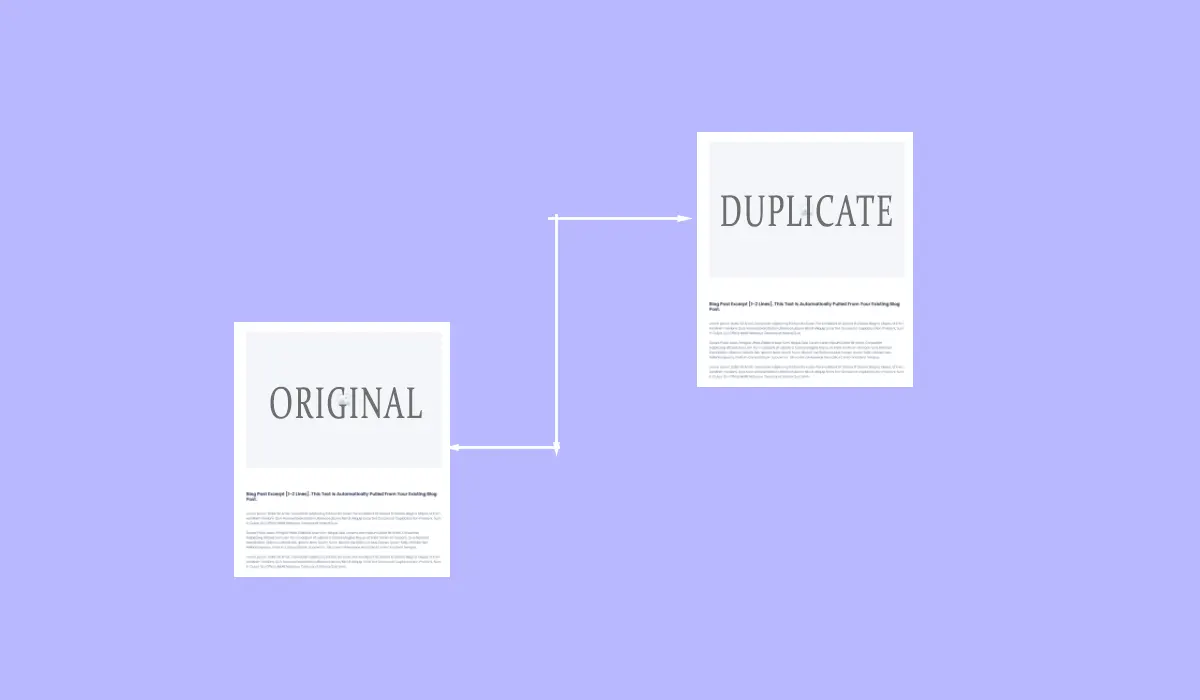
Duplicate content is an SEO issue because it confuses search engines, dilutes ranking signals, wastes crawl budget, and reduces your chances of ranking competitively. When multiple URLs contain identical or substantially similar content, search engines struggle to determine which version should appear in search results. This can split backlinks, lower authority, and suppress visibility. While duplicate content rarely causes a manual penalty, it significantly impacts organic performance, indexation efficiency, and keyword positioning. Fixing it improves clarity, strengthens topical authority, and helps search engines trust and rank your website more effectively.
What Is Duplicate Content in SEO?
Duplicate content refers to blocks of content that are identical or significantly similar across:
- Multiple pages on the same website
- Different domains
- Variations of URLs (HTTP vs HTTPS, www vs non-www)
- Parameterized URLs
- Printer-friendly versions
According to Google, duplicate content generally means “substantive blocks of content within or across domains that either completely match other content or are appreciably similar.”
Types of Duplicate Content
| Type | Description | Example |
|---|---|---|
| Internal Duplicate Content | Same content across multiple pages on one site | Category pages with identical product descriptions |
| External Duplicate Content | Content copied across different domains | Syndicated blog posts without canonical tags |
| Technical Duplication | URL variations serving same content | example.com/page vs example.com/page/ |
| Near-Duplicate Content | Slightly rewritten but mostly identical | Location pages with swapped city names |
Why Do Search Engines Care About Duplicate Content?
Search engines aim to provide diverse, relevant results. Duplicate pages create inefficiencies.
1. It Dilutes Ranking Signals
If backlinks point to different versions of the same page:
- Authority splits
- Link equity weakens
- No single URL ranks strongly
2. It Wastes Crawl Budget
Search engines allocate limited crawl resources per site. Duplicate URLs:
- Consume crawl frequency
- Delay indexing of important pages
- Reduce overall site efficiency
3. It Creates Indexation Confusion
Search engines must decide:
- Which version to index
- Which version to rank
- Whether to ignore all versions
This decision-making process can suppress visibility.
4. It Weakens Topical Authority
Topical authority depends on structured, unique, and semantically rich content. Duplicate pages:
- Compete with each other
- Reduce keyword clarity
- Fragment internal link strength
Does Duplicate Content Cause a Google Penalty?
Many people fear penalties. Reality is more nuanced.
Google rarely applies manual penalties for duplicate content unless there is clear intent to manipulate rankings.
However:
- Algorithmic filtering happens frequently
- Pages may be excluded from results
- Rankings may fluctuate
Penalty is not the main risk. Suppressed performance is.
How Duplicate Content Impacts SEO Metrics
| SEO Element | Impact of Duplicate Content |
|---|---|
| Rankings | Keyword cannibalization |
| Backlinks | Link equity split |
| Crawl Budget | Wasted resources |
| Index Coverage | Incorrect page indexed |
| User Experience | Confusing navigation |
| CTR | Reduced snippet uniqueness |
What Is Keyword Cannibalization and How Is It Related?
Keyword cannibalization happens when multiple pages target the same keyword.
Example:
- /seo-services
- /best-seo-services
- /professional-seo-services
If content overlaps heavily, search engines rotate rankings between pages, lowering stability and performance.
Duplicate content is often the root cause of cannibalization.
Common Causes of Duplicate Content
Technical Causes
- URL parameters
- Session IDs
- HTTP and HTTPS versions
- Trailing slash variations
- Pagination issues
- Faceted navigation
Content Strategy Issues
- Thin location pages
- Reused service descriptions
- Product description duplication
- Syndicated content without canonicalization
How to Identify Duplicate Content
Step 1: Use Google Search Operators
Search:
site:yourdomain.com "exact sentence"
Step 2: Check in Google Search Console
Look for:
- Duplicate without user-selected canonical
- Alternate page with proper canonical
Step 3: Use SEO Tools
Tools like:
These help analyze duplication, canonicals, and indexing issues.
How to Fix Duplicate Content Step by Step
1. Implement Canonical Tags
Add:
<link rel="canonical" href="preferred-url" />
This tells search engines which version to prioritize.
2. Use 301 Redirects
Redirect duplicate URLs to the main version.
Best used for:
- HTTP to HTTPS
- Non-www to www
- Old URLs
3. Consolidate Similar Pages
Merge thin or overlapping content into one authoritative page.
4. Rewrite Near-Duplicate Content
Add:
- Unique value
- Localized information
- Specific examples
- Structured FAQs
5. Improve Internal Linking
Link consistently to canonical URLs.
6. Manage Syndicated Content Properly
If content appears elsewhere:
- Request canonical attribution
- Use noindex if needed
Internal vs External Duplicate Content: What Is Worse?
Internal duplication is more common and easier to fix.
External duplication is riskier if your site is not the original source.
Search engines try to determine content origin, but smaller sites often lose visibility if larger domains republish the same content.
How Duplicate Content Affects AEO and AI Search
Answer Engine Optimization relies on:
- Clear content hierarchy
- Unique semantic signals
- Structured data
Duplicate content:
- Confuses entity association
- Weakens snippet eligibility
- Reduces trust signals
AI systems prioritize authoritative, structured, and distinct content.
Best Practices to Prevent Duplicate Content
- Maintain consistent URL structure
- Use canonical tags
- Avoid copying manufacturer descriptions
- Create unique service and location pages
- Audit content quarterly
- Use structured data strategically
FAQ
Not always. Technical duplication like printer pages is manageable with canonicals. Issue becomes serious when it impacts rankings, indexing, or authority distribution.
Manual penalties are rare. Most impact happens algorithmically through filtering and ranking suppression rather than direct punishment.
There is no exact percentage. Significant similarity in structure, phrasing, and keyword targeting can trigger duplication filtering.
Duplicate content refers to SEO indexing issues. Plagiarism involves copying without permission and may involve copyright violations.
Minor wording changes are not enough. Content must provide distinct value, depth, and intent differentiation.
Deletion is not always required. Better solutions include canonicalization, consolidation, or rewriting depending on strategic goals.
Yes if copied from manufacturers. Unique product descriptions help differentiate ecommerce sites and improve rankings.
Yes. Location pages with identical content except city names often fail to rank due to lack of unique local signals.
Why Ashfaq Digital Is the Right Partner to Fix Duplicate Content
Ashfaq Digital focuses on technical precision, semantic optimization, and scalable SEO architecture. We do not just remove duplication. We restructure content ecosystems.
Our advantages:
- Advanced technical SEO audits
- Strategic content consolidation
- Canonical mapping frameworks
- Keyword cannibalization prevention systems
- AI search optimization integration
Businesses working with us experience:
- Improved crawl efficiency
- Stronger keyword rankings
- Higher topical authority
- Better conversion-driven content structure
Ready to Eliminate Duplicate Content and Boost Rankings?
Duplicate content silently suppresses growth. Fixing it unlocks performance.
Let Ashfaq Digital conduct a full technical and content audit, restructure your SEO framework, and build authority that search engines trust.